


Country Info | Read more

Flags are sourced from free platforms like flagpedia.net
Central African Republic
Step into the Central African Republic, a wilderness calling to the boldest explorers. Glide past forest elephants in Dzanga-Sangha and experience the profound stillness of an untouched natural world.
* Affiliate links are marked with an asterisk (*). We may earn a commission at no extra cost to you.
Photos without credits are sourced from free platforms like Unsplash and Pexels


Summary
Neighboring Countries
Did you know?
Elephant Gathering – The Dzanga Bai is a magical forest clearing where hundreds of elusive forest elephants gather daily!
Overview
Months
April, December, February, January, June, March, May, November
Vacation type
Safari, Rainforest
Expenses
0-50€, <100€, <150€, <200€, Over 200€
Temperature
25-30°C, Over 30°C
Rainfall
0-50mm, 100-150mm, 50-100mm, 150-200mm
Safety
Dangerous
Continent
Africa
Currency
Central African CFA franc
Languages
Sango, French
Currency Converter
When to visit
Travel to this country is currently not recommended or possible due to the ongoing war.
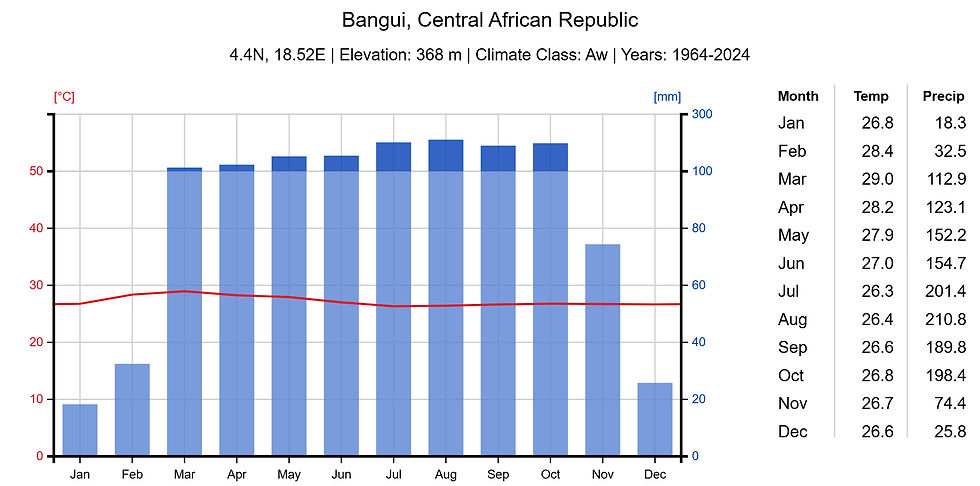
The optimal periods for travel to the Central African Republic are the dry season months (December to March). Weather during this timeframe is characterized by elevated temperatures and minimal precipitation. These conditions support terrestrial navigation, optimize wildlife observation in the southwestern rainforests, and facilitate regional transit on unpaved infrastructure.
The primary travel window aligns with the dry season. This period corresponds with the highest accessibility to remote national reserves and operational stability for domestic charter flights. Accommodation and private transport costs remain high due to scarce infrastructure and limited supply.
The rainy season (May to October) brings high humidity and heavy, sustained precipitation. This period severely compromises overland transit, causing significant mud accumulation and localized flooding. Access to regional wildlife reserves becomes logistically prohibitive or entirely blocked during these months.
-
Plan the whole vacation, including flights, transportation, hotels and tours with Expedia *

Climate Data
Peak Season (December to March)
Average Sunny Hours per Day: 7 to 9 hours.
Rain Frequency: Precipitation is minimal.
Rainy Hours per Day: Less than 1 hour.
Intensity: Rain events are rare and localized.
Duration: Showers typically dissipate rapidly.
Off-Peak Season (May to October)
Average Sunny Hours per Day: 4 to 6 hours.
Rain Frequency: Precipitation is frequent, occurring almost daily.
Rainy Hours per Day: 3 to 6 hours.
Intensity: Rain is intense and compromises unpaved road networks.
Duration: Storm systems can last from several hours to multiple days.
Climate Chart
_edited_edited_edited_e.jpg)
Data Source: Global Historical Climatology Network
ClimateCharts.net
Weather, Crowds and Costs
Per one person
Tourist Season: December-March
Budget Travel ($50-90/day)
Accommodation: $30-50/night (basic guesthouses in Bangui).
Food: $10-20/day (local markets, informal street stalls).
Activities: $5-10/day (public museum entry fees).
Transportation: $5-10/day (shared minibuses, urban moto-taxis).
Other Costs: $2-5/day (bottled water, incidental expenses).
Mid-Range Travel ($150-300/day)
Accommodation: $80-150/night (standard secure hotels in the capital).
Food: $30-50/day (mid-range restaurants).
Activities: $20-60/day (guided local municipal tours).
Transportation: $20-40/day (private urban taxis).
Other Costs: $5-15/day (local goods).
Luxury Travel ($400+/day)
Accommodation: $200+/night (secure premium hotels, private eco-lodges).
Food: $60+/day (upscale international dining).
Activities: $100+/day (specialized wildlife permits, private logistical support).
Transportation: $150+/day (private 4x4 vehicle with driver and security detail).
Other Costs: $20+/day (premium goods).
Off-Peak Season: May-October
Budget Travel ($45-80/day)
Accommodation: $25-45/night (basic lodgings).
Food: $10-15/day (local markets).
Activities: $5-10/day (indoor sites).
Transportation: $5-10/day (shared transit).
Other Costs: $2-5/day (incidentals).
Mid-Range Travel ($130-250/day)
Accommodation: $70-130/night (standard hotels).
Food: $25-45/day (standard restaurants).
Activities: $20-50/day (accessible guided tours).
Transportation: $20-35/day (taxis).
Other Costs: $5-10/day (goods).
Luxury Travel ($350+/day)
Accommodation: $180+/night (premium hotels).
Food: $50+/day (premium dining).
Activities: $80+/day (private guided logistics).
Transportation: $120+/day (private secure transit).
Other Costs: $15+/day (premium goods).
-
You can find accomendations that fit your trip and budget on Booking.com, Vrbo and Hotels.com


Best Regions to visit
Cities
1. Bangui
- The capital and primary urban center, situated on the banks of the Oubangui River. It serves as the sole international point of entry and the administrative core of the nation.
2. Bayanga
- A remote settlement in the southwestern prefecture of Sangha-Mbaéré. It functions as the logistical gateway for accessing the Dzanga-Sangha Special Reserve.
3. Bouar
- A regional capital located in the western highlands. It is recognized for its temperate climate and proximity to ancient archaeological stone formations.
4. Mbaïki
- The capital of the Lobaye prefecture, situated south of Bangui. The local economy relies on timber and agricultural production, specifically coffee and timber.
5. Zinga
- A riverine town located on the Oubangui River, roughly 100 kilometers downstream from the capital. It is recognized for traditional regional architecture.
Bangui

Did you know?
Darkest Skies – The country has almost zero light pollution, making it one of the absolute best places on Earth for stargazing!
Islands
Central African Republic is a landlocked country and does not have islands in the traditional sense.
-
Find the perfect place to stay in any of these top cities and islands with Booking.com, Hotels.com and Vrbo – offering entire homes and apartments for a comfortable and private experience.

Things to see
Natural Attractions
1. Dzanga-Sangha Special Reserve
- A protected rainforest zone in the southwest. The ecosystem harbors significant populations of western lowland gorillas and forest elephants.
2. Boali Waterfalls
- A hydrological feature located northwest of Bangui where the M'Bari River cascades over a 50-meter drop. A nearby hydroelectric facility regulates the water flow.
3. Manovo-Gounda St. Floris National Park
- A UNESCO World Heritage site in the northeast containing vast savannah and wetland biomes. Fauna populations have been severely impacted by poaching.
4. Dzanga Bai
- A large, mineral-rich clearing within the Dzanga-Sangha rainforest. It functions as a primary gathering site for hundreds of forest elephants and bongo antelopes.
5. Chinko Nature Reserve
- A managed conservation area in the eastern sector, protecting a transition zone between the Congo basin rainforests and the Sudanian savannah.
Historical and Cultural Sites
1. Boganda National Museum
- A cultural facility situated in Bangui, dedicated to documenting the ethnographic history, traditional instruments, and daily implements of the nation's diverse ethnic groups.
2. Berengo Palace
- The deteriorating former estate of Jean-Bédel Bokassa, the self-proclaimed Emperor of the Central African Empire, located outside Bangui.
3. Bouar Megaliths
- A collection of large standing stones (tajunu) dating back to the late Neolithic era, distributed across the landscape surrounding the town of Bouar.
4. Notre-Dame of Bangui Cathedral
- A prominent red-brick Catholic cathedral constructed during the French colonial era, serving as a primary architectural landmark in the capital.
5. Zinga Wooden Houses
- Traditional residential structures constructed entirely of timber, demonstrating historical construction methods adapted to the riverine environment.
Unique Experiences
1. Tracking Western Lowland Gorillas
- Utilizing experienced guides and trackers in the Dzanga-Sangha Reserve to approach habituated primate groups in dense rainforest terrain.
2. Engaging with Ba'aka Communities
- Observing traditional net-hunting techniques and medicinal plant applications with the indigenous Ba'aka population in the southwestern forests.
3. Navigating the Oubangui River
- Chartering motorized pirogues from Bangui to transit the primary waterway separating the Central African Republic from the Democratic Republic of the Congo.
-
The best way to explore major cities and must-see attractions is by booking guided tours.* They offer convenience, local insights, and often save time when visiting popular sights.

Unique Accomondations/Foodspots
Accommodations
Sangha Lodge
Location: Dzanga-Sangha Special Reserve
You get to stay in a remote eco-lodge hidden deep within the untouched rainforest of the Congo Basin. From your cabin, you can trek to a secret forest clearing called a "bai" to safely watch hundreds of wild forest elephants and rare western lowland gorillas gather in the mud.
Restaurants/Bars
Hotel Oubangui Terrace
Location: Bangui
This open-air terrace sits right on the edge of the massive, fast-flowing Oubangui River. You can grab a cold local beer and watch traditional wooden canoes drift by while looking directly across the water at the dense jungles of the Democratic Republic of Congo.
Tours to do
1. Observing Forest Elephants at Dzanga Bai
- Utilizing elevated wooden observation platforms situated on the perimeter of the mineral clearing to survey congregating megafauna.
Best Time: December to February
Average Cost: $105 – $120 per person per day (covers mandatory park entrance and specific observation permits; excludes transit and lodging)
2. Dzanga-Sangha Wildlife Expedition
- A complex logistical operation requiring charter flights from Bangui to Bayanga. The itinerary focuses on gorilla tracking and elephant observation at the Dzanga Bai.
Best Time: December to March
Average Cost: $1,500 – $3,000+ per person (excluding international flights)
3. Boali Falls and Mbaïki Route
- A vehicular transit from Bangui through the southern forested zones. The excursion covers the hydroelectric waterfall and regional timber settlements.
Best Time: Year-round
Average Cost: $150 – $300 per person
4. Ba'aka Cultural Immersion
- A specialized component of the Bayanga itinerary involving direct observation of indigenous foraging and construction methodologies.
Best Time: December to March
Average Cost: $100 – $200 per person
5. Bangui Historical and Architectural Survey
- An urban transit operation inspecting the Boganda Museum, the central market, and the colonial-era cathedral structures.
Best Time: Year-round
Average Cost: $50 – $100 per person
Forest Elephants

How to get around
1. Charter Flights
- Private aviation is the sole reliable method for transiting between Bangui and remote regional airstrips (e.g., Bayanga) due to compromised terrestrial infrastructure.
2. Private 4x4 Vehicles
- Procuring a reinforced four-wheel-drive vehicle with an experienced local driver is mandatory for overland transit outside the capital.
3. Pirogues (Motorized Canoes)
- Traditional timber vessels equipped with outboard motors serve as the primary transport method along the Oubangui and Sangha rivers.
4. Urban Taxis
- Registered yellow taxis operate within Bangui. Fares must be negotiated in advance, and exclusive use of the vehicle must be explicitly requested.
5. Moto-Taxis
- Motorcycle taxis provide transit within urban limits. Safety standards are unregulated, and helmet usage is infrequent.
For security and efficiency, charter flights are required for interprovincial travel, while private escorted vehicles are strictly advised for all necessary ground transit.
-
You can find great car rental deals for your vacation on Expedia *
Did you know?
UNESCO Music – The native Aka Pygmy people have a complex polyphonic singing style so rare it's officially protected by UNESCO!
What to eat
1. Cassava (Gozo)
- The primary dietary staple. Cassava root is processed, milled, and boiled into a dense, starchy paste utilized to consume regional sauces and stews.
2. Maboké
- A traditional preparation involving fresh river fish seasoned with local spices, wrapped tightly in large Marantaceae leaves, and steamed or roasted over an open fire.
3. Foutou
- A compacted carbohydrate side dish synthesized by pounding boiled plantains or yams into a heavy consistency.
4. Nganda
- A localized term often referring to informal establishments serving grilled meats (predominantly goat or beef) cooked over charcoal braziers.
5. Gombo
- A viscous stew prepared utilizing okra, palm oil, and available proteins, functioning as a standard accompaniment to cassava paste.
Cassava (Gozo)

Photo By Neil Palmer https://commons.wikimedia.org/wiki/File:Cassava_on_the_Sawla_market.jpg
Flights
Flight prices are approximate and vary by departure city, airline, and booking time. Check airlines or travel platforms for the latest details.
* Please note: All prices are rough estimates for orientation purposes only and may vary by region.
Main Airport: Bangui M'Poko International Airport (BGF)
Flight Prices and Seasons:
From Europe
- Average Round-Trip Cost: €800 to €1,600.
- Cheapest Months: October and November.
- Peak Prices: July, August, and December.
From North America
- Average Round-Trip Cost: $1,400 to $2,500.
- Cheapest Months: February and March.
- Peak Prices: June to August and December.
From Asia
- Average Round-Trip Cost: $1,500 to $2,800.
- Cheapest Months: September and October.
- Peak Prices: December and January.
From Australia
- Average Round-Trip Cost: $2,000 to $3,500.
- Cheapest Months: May and November.
- Peak Prices: December and January.
From Africa
- Average Round-Trip Cost: $400 to $1,000 (often via transit hubs in Cameroon, Ethiopia, or Kenya).
- Cheapest Months: March and October.
- Peak Prices: August and December.
-
You can find the best flight deals with Skyscanner or plan the whole vacation, including flights, transportation, hotels and tours with Expedia *
Airport Location
Visa
1. Visa Requirement
- A valid visa is strictly mandated for all foreign nationals prior to arrival.
2. Consular Processing
- Visas must be obtained from a Central African Republic embassy or consulate. Processing times vary significantly, and electronic visa systems are not currently utilized.
3. Required Documentation
- Applications necessitate a passport valid for six months beyond the intended stay, a confirmed return ticket, and an official letter of invitation or confirmed hotel reservation.
4. Health Requirements
- A Yellow Fever vaccination certificate is mandatory for entry and is inspected by border control. Strict malaria prophylaxis and comprehensive routine vaccinations are highly advised.
5. Travel Insurance
- Procuring comprehensive medical evacuation insurance is considered an operational necessity due to the absence of advanced medical infrastructure.
Important things to know
1. Payments
- The official currency is the Central African CFA franc (XAF). The economy functions almost entirely on a cash basis. Credit card terminals are largely non-existent, except in a few major international hotels in Bangui.
2. Tap Water
- Municipal tap water is not biologically safe for consumption. Reliance on commercially sealed bottled water or heavy purification systems is required.
3. Electricity
- The standard voltage is 220V. Plug types C and E (two round pins) are standard. The national power grid is highly unstable, and reliance on private generators is standard protocol.
4. Tipping
- Tipping is not a formal social requirement but is expected by guides and service staff interacting with foreign visitors. Small cash increments (5-10%) are standard.
5. SIM Cards
- Telecommunication providers (e.g., Orange, Telecel) supply local SIM cards in Bangui. Connectivity outside the capital is highly unreliable.
6. Driving Side
- Vehicles operate on the right side of the road.
Souveniers
1. Butterfly Art
- Intricate collages and artistic compositions assembled utilizing the wings of diverse butterfly species native to the regional rainforests.
2. Ebony Carvings
- Dense, hardwood sculptures crafted by regional artisans, typically depicting wildlife or traditional anthropogenic figures.
3. Woven Rattan Products
- Functional baskets, mats, and storage containers manufactured utilizing natural rattan fibers sourced from the southern forest zones.
Woven Rattan Products

Location
Reviews
You already visited this country? Share your experiences with others! Tell us what’s worth seeing, what to skip, the things you wish you knew before your trip, what surprised you, what do you wish you knew earlier? Leave a review and help others plan smarter. Thanks in advance! :))