


Country Info | Read more

Flags are sourced from free platforms like flagpedia.net
Argentina (South)
The south is all about the wild beauty of Patagonia. You can hike near sharp mountain peaks, watch penguins on the coast, or hear the loud crack of giant glaciers breaking into the water. It is a dream destination for anyone who loves the great outdoors and cold, fresh air.
* Affiliate links are marked with an asterisk (*). We may earn a commission at no extra cost to you.
Photos without credits are sourced from free platforms like Unsplash and Pexels


Did you know?
Backward River – In Patagonia, the La Leona River uniquely flows backward from Lake Viedma into Lake Argentino, defying normal gravity slopes.
Overview
Months
April, August, December, February, January, July, June, March, May, November, October, September
Vacation type
Beach, Couple, Family, Mountains, Skiing
Expenses
<100€, <150€, <200€, Over 200€
Temperature
0-10°C, 10-20°C
Rainfall
0-50mm
Safety
Very safe
Continent
South America
Currency
Argentine peso
Languages
Spanish
Currency Converter
When to visit
The ideal time to explore Southern Argentina—encompassing the vast Patagonian steppe, the Lake District, and Tierra del Fuego—is the austral summer, from November to March. During these months, the formidable Andean trails in Los Glaciares National Park clear of snow, and daytime temperatures hover between 10°C and 20°C. In the extreme south, daylight stretches up to 18 hours, providing extended windows for alpine trekking and glacier navigation.
The off-peak winter season (June to September) brings fierce, sub-zero cold, heavy snowfall, and drastically shorter days. While remote trekking hubs like El Chaltén and southern lodges often shutter entirely due to impassable ice, this period transforms the region into a premier winter sports destination, drawing skiers to the slopes of Bariloche and Ushuaia.
Spring (October) and Autumn (April) offer fiery foliage and fewer crowds, but travelers must brace for the legendary, gale-force Patagonian winds that frequently ground flights and halt boat tours
-
Plan the whole vacation, including flights, transportation, hotels and tours with Expedia *

Climate Data
Peak Season (November to March)
Average Sunny Hours per Day: 7 to 9 hours.
Rain Frequency: 5 to 8 days per month.
Rainy Hours per Day: 2 to 3 hours.
Intensity: Sharp, sudden rain squalls driven by intense winds.
Duration: Weather changes rapidly; clear blue skies can be overtaken by localized snow or rain within minutes, particularly near the ice fields.
Off-Peak Season (June to September)
Average Sunny Hours per Day: 3 to 5 hours.
Rain Frequency: 10 to 15 days per month (falling predominantly as snow).
Rainy Hours per Day: 4 to 6 hours.
Intensity: Heavy, accumulating blizzards in the Andes; freezing sleet along the southern coasts.
Duration: Multi-day winter storm systems that frequently close Route 40 and isolate smaller mountain communities.
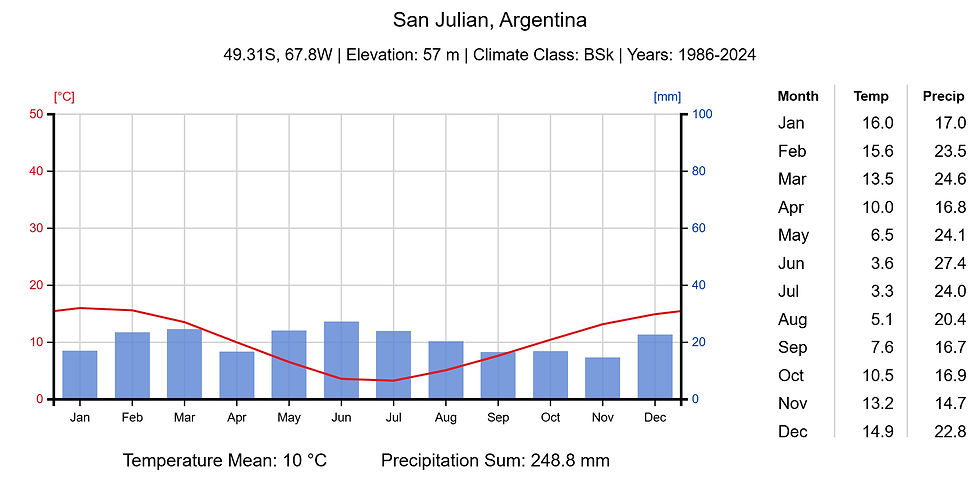
Climate Chart
_edited_edited_edited_e.jpg)
Data Source: Global Historical Climatology Network
ClimateCharts.net
Weather, Crowds and Costs
Per one person
Tourist Season: November-March
1. Basic / Essential Travel ($45-75/day)
Accommodation: $20-35/night (bunk beds in hiker hostels in El Chaltén, municipal campgrounds).
Food: $15-25/day (supermarket provisions for trail lunches, empanadas, local bakeries).
Activities: $5-10/day (national park entry fees for independent hiking).
Transportation: $5-10/day (local buses, sharing fuel costs with other travelers).
Other Costs: $5/day (bottled water, trail snacks).
2. Mid-Range Travel ($120-220/day)
Accommodation: $70-130/night (heated, comfortable 3-star alpine lodges or independent cabins).
Food: $30-50/day (sit-down dinners featuring local lamb, craft beer, and regional wine).
Activities: $40-80/day (boat tours to the glacier faces, guided penguin colony walks).
Transportation: $30-60/day (long-distance sleeper buses between major hubs, or splitting a standard rental car).
Other Costs: $10-15/day (crampon rentals, incidentals).
3. Luxury / Premium Travel ($400 - $900+/day)
Accommodation: $250-600+/night (premium, all-inclusive wilderness lodges overlooking the glaciers, or 5-star spa resorts in Bariloche).
Food: $80-150+/day (gourmet Patagonian tasting menus, high-end exported Malbecs).
Activities: $150-400+/day (guided ice-trekking directly on the Perito Moreno glacier, private boat charters in the Beagle Channel).
Transportation: $100-200+/day (domestic flights to skip the massive driving distances, premium 4x4 SUV rentals.
Other Costs: $30+/day (premium gratuities for specialized mountain guides).
Off-Peak Season: June-September
1. Basic / Essential Travel ($40-65/day)
Accommodation: $15-25/night.
Food: $15-25/day.
Activities: $5-10/day (snowshoeing on accessible lower trails).
Transportation: $5-10/day.
Other Costs: $5/day.
2. Mid-Range Travel ($100-180/day)
Accommodation: $60-100/night (winter rates apply to open lodges).
Food: $25-45/day.
Activities: $40-80/day (lift tickets for basic skiing, museum entries).
Transportation: $30-50/day (4WD vehicle becomes mandatory for independent driving).
Other Costs: $10/day.
3. Luxury / Premium Travel ($350 - $750+/day)
Accommodation: $200-500+/night (ski-in/ski-out luxury chalets).
Food: $70-120/day.
Activities: $100-250+/day (private ski instruction, snowmobile tours).
Transportation: $80-150/day (private chauffeured 4x4 transfers).
Other Costs: $20/day.
-
You can find accomendations that fit your trip and budget on Booking.com, Vrbo and Hotels.com


Best Regions to visit
Cities
1. San Carlos de Bariloche
- The gateway to the northern Lake District. It is defined by its striking alpine architecture, massive chocolate industry, and position on the shores of the deep blue Nahuel Huapi Lake, surrounded by jagged peaks and ski resorts.
2. El Calafate
- A booming tourist hub situated on the edge of the Southern Patagonian Ice Field. It exists almost entirely to service the massive influx of visitors heading to the nearby Perito Moreno Glacier, offering excellent dining and high-end lodgings.
3. El Chaltén
- A rustic, wind-battered frontier village universally recognized as Argentina's trekking capital. It sits directly at the base of the iconic Mount Fitz Roy and Cerro Torre, with world-class trails starting right at the edge of town.
4. Ushuaia
- Marketed heavily as the "End of the World," this is the southernmost city on the planet. Framed by the Martial Mountains and the frigid waters of the Beagle Channel, it serves as the primary global departure port for Antarctica expeditions.
San Carlos de Bariloche

Did you know?
Growing Glacier – Unlike most melting glaciers worldwide, the Perito Moreno Glacier is one of the few that continuously advances and ruptures in spectacular ice avalanches.
Islands
1. Tierra del Fuego
- An immense, triangular island shared by Argentina and Chile at the extreme southern tip of the continent. It is a harsh, dramatically beautiful landscape of peat bogs, wind-warped trees, and sub-antarctic forests.
2. The Beagle Channel
- A vital, narrow marine strait separating the main island of Tierra del Fuego from a series of smaller, uninhabited islands. It is heavily navigated by catamarans taking visitors to view sea lion colonies and the iconic Les Eclaireurs Lighthouse.
3. Martillo Island
- A small island located in the Beagle Channel, famous for hosting significant, highly accessible breeding colonies of Magellanic and Gentoo penguins during the summer months.
-
Find the perfect place to stay in any of these top cities and islands with Booking.com, Hotels.com and Vrbo – offering entire homes and apartments for a comfortable and private experience.
Tierra del Fuego

Things to see
Natural Attractions
1. Perito Moreno Glacier
- One of the few glaciers on earth that is currently advancing rather than retreating. Visitors can stand on extensive steel walkways just meters from its massive, 60-meter-high sheer blue face, listening to the thunderous cracks as huge blocks of ice calve into Lake Argentino.
2. Mount Fitz Roy
- A jagged, imposing granite monolith that dominates the skyline of Los Glaciares National Park. The challenging day hike to Laguna de los Tres at its base offers one of the most famous mountain vistas in the world.
3. Península Valdés
- Located on the arid Atlantic coast of northern Patagonia, this globally significant marine sanctuary is a prime location for spotting southern right whales, elephant seals, and orcas that notoriously hunt seals directly on the shoreline.
Historical and Cultural Sites
1. Cueva de las Manos (Cave of the Hands)
- An isolated, deeply moving archaeological site located in a remote canyon off Route 40. The rock walls are covered with hundreds of stenciled, overlapping handprints and hunting scenes painted by indigenous hunter-gatherers up to 10,000 years ago.
2. The End of the World Train
- Originally built to transport timber for the brutal penal colony in Ushuaia, this narrow-gauge railway now takes passengers on a scenic, historical journey into the pristine landscapes of Tierra del Fuego National Park.
3. Welsh Settlements (Gaiman and Trelew)
- In the Chubut province, a distinct cultural anomaly exists: towns founded by Welsh immigrants in the 19th century. Visitors can still sit in traditional Welsh tea houses, eat torta negra (black cake), and hear the Welsh language spoken.
Unique Experiences
1. Ice Trekking in El Calafate
- Strapping heavy steel crampons onto your hiking boots to walk directly across the fractured, undulating surface of the Perito Moreno Glacier, navigating deep blue crevasses and drinking whiskey chilled with glacial ice.
2. Navigating the Beagle Channel
- Sailing out of Ushuaia through the frigid waters of the channel to view the rugged, isolated islands, watching cormorants dive and keeping an eye out for breaching humpback whales in the sub-antarctic waters.
3. Driving the Seven Lakes Route
- Renting a car to drive the spectacular section of Route 40 between San Martín de los Andes and Villa La Angostura, tracing a winding path past seven distinct, crystal-clear alpine lakes reflecting the surrounding forests.
-
The best way to explore major cities and must-see attractions is by booking guided tours.* They offer convenience, local insights, and often save time when visiting popular sights.
Mount Fitz Roy

Unique Accomondations/Foodspots
Accommodations
Awasi Patagonia
Location: Torres del Paine reserve border / Argentine Patagonia
An exclusive wilderness lodge consisting of private, stilted villas scattered across a private reserve overlooking the dramatic peaks of Torres del Paine, each equipped with its own dedicated private guide and 4x4 vehicle.
Restaurants / Bars
Il Rustico
Location: El Calafate, Santa Cruz, South Argentina
A cozy, highly acclaimed patagonian culinary gem celebrated for its artisanal house-made pastas, local lamb dishes, and warm, rustic hospitality welcoming travelers returning from the nearby Perito Moreno Glacier.
Tours to do
1. The Glaciers and Peaks Circuit
- A 7-to-9 day highly focused itinerary. Fly into El Calafate to spend two days at the Perito Moreno glacier. Take the 3-hour bus north to El Chaltén, dedicating four days to completing the Laguna de los Tres and Laguna Torre hikes, before returning to El Calafate for departure.
Best Time: December to March
Average Cost: $800 – $1,500 per person
2. The End of the World Explorer
- A 5-day journey based entirely in Ushuaia. Ride the historic train into Tierra del Fuego National Park for coastal hiking, take a full-day catamaran cruise down the Beagle Channel to walk among the penguins on Martillo Island, and hike up to the Martial Glacier.
Best Time: November to February
Average Cost: $600 – $1,100 per person
El Calafate

How to get around
1. Domestic Aviation
- The only realistic way to cover the immense distances of Patagonia unless you have weeks to spare. Carriers like Aerolíneas Argentinas and Flybondi connect Buenos Aires directly to Bariloche, El Calafate, and Ushuaia.
2. Long-Distance Buses
- Large, comfortable double-decker buses run reliable routes between major towns (e.g., El Calafate to El Chaltén). However, for longer, cross-provincial routes, the travel times are massive (often exceeding 24 hours).
3. Rental Cars
- Essential for exploring the Lake District or the remote Atlantic coast. If driving the legendary Route 40, be prepared for hundreds of kilometers of unpaved, bone-rattling gravel (ripio). Ensure your rental includes a spare tire and cross-border permits if you plan to enter Chile.
4. Ferries and Catamarans
- The primary method for exploring the Beagle Channel, reaching penguin colonies, or crossing the border through the Andean lakes between Bariloche and Puerto Varas (Chile).
-
You can find great car rental deals for your vacation on Expedia *
Did you know?
Growing Glacier – Unlike most melting glaciers worldwide, the Perito Moreno Glacier is one of the few that continuously advances and ruptures in spectacular ice avalanches.
What to eat
1. Asado
- A traditional Argentine barbecue featuring various cuts of beef, pork, and sausages grilled over an open flame.
2. Empanadas
- Savory pastry filled with meats, cheese, or vegetables, often spiced with cumin and paprika.
3. Milanesa
- Breaded and fried beef or chicken cutlets, similar to schnitzel, often served with mashed potatoes or salad.
4. Chimichurri
- A tangy and herby sauce made with parsley, garlic, vinegar, and olive oil, typically served with grilled meats.
5. Dulce de Leche
- A sweet caramel-like spread made from slowly heating milk and sugar, used in desserts like alfajores or simply enjoyed on its own.
Asado

Flights
Flight prices are approximate and vary by departure city, airline, and booking time. Check airlines or travel platforms for the latest details.
* Please note: All prices are rough estimates for orientation purposes only and may vary by region.
Main Airport: San Carlos de Bariloche Airport (BRC)
Flight Prices and Seasons
From Europe
- Average Round-Trip Cost: €1,000 to €1,700 (Direct flights into Buenos Aires via Iberia, KLM, or Lufthansa, followed by a 2.5-hour domestic flight to Bariloche).
- Cheapest Months: May and October.
- Peak Prices: July (winter ski season), August, and late December.
From North America
- Average Round-Trip Cost: $1,100 to $1,900 (Direct routes into EZE from Miami, New York, or Atlanta via American Airlines or Delta, then connecting south).
- Cheapest Months: September and November.
- Peak Prices: December through February, and July.
From Asia
- Average Round-Trip Cost: $1,600 to $2,700 (Complex transit requiring layovers in the Middle East or US before reaching Argentina).
- Cheapest Months: April and October.
- Peak Prices: January and July.
From Australia
- Average Round-Trip Cost: $1,300 to $2,200 (Routed via Qantas or LATAM through Santiago, Chile, often connecting directly to major Argentine hubs).
- Cheapest Months: August and November.
- Peak Prices: December and January.
From Africa
- Average Round-Trip Cost: $1,200 to $2,000 (Connecting through São Paulo, Brazil via Ethiopian Airlines).
- Cheapest Months: March and September.
- Peak Prices: December.
-
You can find the best flight deals with Skyscanner or plan the whole vacation, including flights, transportation, hotels and tours with Expedia *
Airport Location
Visa
1. Visa Requirement
- Most travelers can enter Argentina visa-free for short stays, including citizens of the U.S., Canada, the U.K., the EU, Australia, and New Zealand.
2. Visa-Free Countries
- Citizens of many countries, including Japan and Brazil, can enter Argentina without a visa for up to 90 days.
3. Visa Application
- Travelers from countries that require a visa must apply at an Argentinian embassy or consulate before traveling.
4. Types of Visa
- Commonly issued as tourist visas (valid for up to 90 days) or business visas.
5. Processing Time
- Visa processing can take several days to a few weeks, so apply well in advance.
6. Duration of Stay
- Most visa-free visitors can stay for up to 90 days, with possible extensions available through local immigration offices.
7. Health Requirements
- No specific vaccinations are mandatory, but travel insurance is recommended for medical emergencies.
Important things to know
1. Payments
- The local currency is the Argentine Peso (ARS). Credit cards are widely accepted, especially in urban areas, but cash is advisable for smaller purchases.
2. Tap Water
- Tap water is generally safe to drink in major cities, but bottled water is often preferred.
3. Electricity
- The voltage is 220V, and plug types C and I (two round pins) are used. An adapter may be needed for devices from other regions.
4. Tipping in Restaurants
- Tipping is customary, with 10-15% being standard for good service in restaurants.
5. SIM Cards
- Local SIM cards are available from providers like Movistar, Claro, and Personal. They can be purchased at stores, offering various prepaid data plans.
6. Driving Side
- In Argentina, people drive on the right side of the road.
Souveniers
1. Mate Set (Gourd & Bombilla)
- Traditional cup and straw for drinking yerba mate.
2. Leather Goods
- High-quality handmade belts, wallets, and bags.
3. Alfajores
- Delicious dulce de leche-filled cookies.
Mate Set

Location
Reviews
You already visited this country? Share your experiences with others! Tell us what’s worth seeing, what to skip, the things you wish you knew before your trip, what surprised you, what do you wish you knew earlier? Leave a review and help others plan smarter. Thanks in advance! :))